
Greetings, devs! In today’s post, we’ll delve into the world of Java object serialization and explore the differences between two key interfaces: Serializable and Externalizable. Understanding these interfaces and their distinct use cases is crucial for effective object serialization in Java. So let’s embark on this enlightening journey and unlock the power of object serialization!
Understanding Object Serialization in Java
Object serialization is the process of converting an object’s state into a byte stream, which can be stored or transmitted and later reconstructed into a new object with the same state. In Java, this process is facilitated by two primary interfaces: Serializable and Externalizable.
Serializable Interface
The Serializable interface is a marker interface that indicates an object can be serialized. It doesn’t define any methods, so classes implementing Serializable only need to declare that they implement the interface.
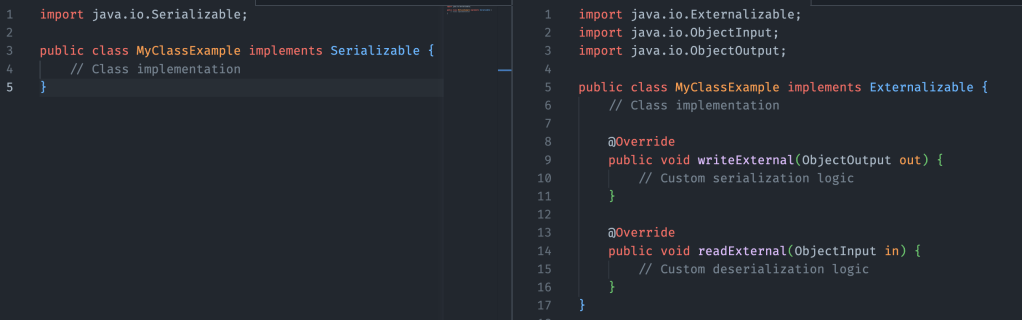
import java.io.Serializable;

public class MyClassExample implements Serializable {
    // Class implementation
}
When a class implements Serializable, Java’s default serialization mechanism handles the serialization and deserialization process. This mechanism uses reflection to save and restore an object’s state, including its fields and their values. However, this default mechanism might not be suitable for all use cases, as it may be slow or inefficient for complex objects.
Externalizable Interface
The Externalizable interface, a subinterface of Serializable, allows you to customize the serialization and deserialization process. By implementing Externalizable, you take control of how your object is converted to a byte stream and reconstructed.
import java.io.Externalizable;
import java.io.ObjectInput;
import java.io.ObjectOutput;

public class MyClassExample implements Externalizable {
    // Class implementation

    @Override
    public void writeExternal(ObjectOutput out) {
        // Custom serialization logic
    }

    @Override
    public void readExternal(ObjectInput in) {
        // Custom deserialization logic
    }
}
When implementing Externalizable, you need to override the writeExternal and readExternal methods, which define custom serialization and deserialization logic, respectively. This level of control enables you to optimize the serialization process for specific use cases.
Key Differences between Serializable and Externalizable
- Ease of Use: Implementing Serializable is simpler, as it requires no additional methods. Externalizable requires you to implement custom serialization and deserialization logic, which can be more complex.
- Performance: Serializable’s default mechanism might be slower for large or complex objects, while Externalizable allows you to optimize performance through custom logic.
- Flexibility: Serializable offers limited control over the serialization process, while Externalizable allows fine-grained control, enabling you to handle specific requirements, such as encrypting data during serialization.
Final Note
In this post, we explored the differences between Serializable and Externalizable interfaces in Java, both of which play a pivotal role in object serialization. Understanding their unique characteristics and use cases is essential for effective Java programming.
📚 Further Reading & Related Topics
If you’re exploring Java object serialization and optimizing data persistence, these related articles will provide deeper insights:
• Java 11 String Methods: A Closer Look at New Additions – Learn how Java has enhanced string handling, which is crucial for working with serialized objects and efficient data storage.
• Difference Between TreeSet and TreeMap in Java – Understand how different data structures affect serialization and how to choose the right one for storing objects efficiently.








 Scalable Human Blog
Leave a comment