
Hello, code connoisseurs! As we venture deeper into the realm of object-oriented programming (OOP), understanding the relationships between objects becomes increasingly important. In this post, we’ll explore three core relationships: association, composition, and aggregation. By distinguishing between these concepts, we’ll gain a solid foundation for designing more robust and maintainable software systems. So, let’s embark on this illuminating journey together!
Unraveling Association, Composition, and Aggregation
Association, composition, and aggregation are three types of relationships that can exist between classes in OOP. They provide a way to establish connections between objects, allowing for code reusability, modularity, and separation of concerns.
- Association: Association is a simple relationship between objects of two separate classes. It can be bi-directional, with both classes being aware of each other, or uni-directional, where only one class is aware of the other. The association can be either one-to-one, one-to-many, or many-to-many.
- Composition: Composition is a strong “has-a” relationship between two classes, where one class (the parent) is composed of one or more instances of another class (the child). When the parent object is destroyed, so are its child objects. This relationship is characterized by strong ownership and strict lifetime dependency between the parent and its children.
- Aggregation: Aggregation is a weaker “has-a” relationship between two classes, where one class (the parent) contains one or more instances of another class (the child), but the child objects can exist independently of the parent object. This relationship is characterized by weak ownership and a more flexible lifetime dependency between the parent and its children.
Key Differences between Association, Composition, and Aggregation
- Ownership: Composition implies strong ownership, while aggregation implies weak ownership. In association, there’s no notion of ownership.
- Lifetime dependency: Composition exhibits strict lifetime dependency, with child objects being destroyed along with the parent. Aggregation, on the other hand, has a more flexible lifetime dependency, as child objects can exist independently of the parent. Association doesn’t involve any lifetime dependency.
- Relationship strength: Composition represents the strongest relationship, followed by aggregation, with association being the weakest.
Examples of Association, Composition, and Aggregation
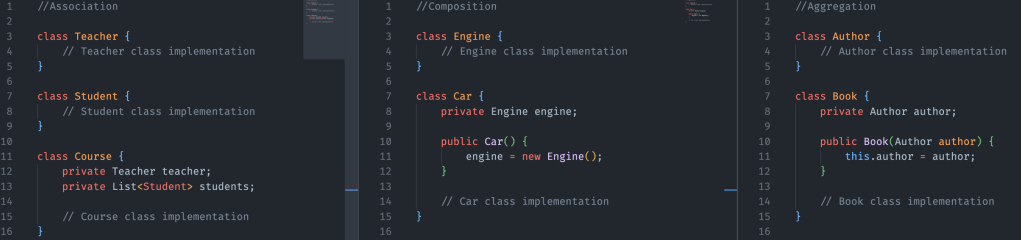
Let’s consider examples that illustrate the differences between association, composition, and aggregation.
- Association:
class Teacher {
    // Teacher class implementation
}

class Student {
    // Student class implementation
}

class Course {
    private Teacher teacher;
    private List<Student> students;

    // Course class implementation
}
In this example, the Course class has a simple association with the Teacher and Student classes.
- Composition:
class Engine {
    // Engine class implementation
}

class Car {
    private Engine engine;

    public Car() {
        engine = new Engine();
    }

    // Car class implementation
}
Here, the Car class has a composition relationship with the Engine class, as the engine is a part of the car and cannot exist independently.
- Aggregation:
class Author {
    // Author class implementation
}

class Book {
    private Author author;

    public Book(Author author) {
        this.author = author;
    }

    // Book class implementation
}
In this example, the Book class has an aggregation relationship with the Author class, as the author can exist independently of the book.
Final Note
In this blog post, we’ve explored the key differences between association, composition, and aggregation, three essential relationships in object-oriented programming. By understanding their unique properties, ownership, lifetime dependencies, and relationship strength, we can make better design decisions and create more robust, maintainable software systems. As you continue your journey through the world of OOP, keep these concepts in mind and strive to create well-structured, modular, and flexible code. Happy coding!
📚 Further Reading & Related Topics
If you’re exploring association, composition, and aggregation in object-oriented programming, these related articles will provide deeper insights:
• Understanding the SOLID Principles in Java: A Foundation for Cleaner Code – Learn how the SOLID principles complement object relationships like composition and aggregation to produce more modular and maintainable code.
• Design Patterns in Java: A Deep Dive into Creational Patterns – Explore how design patterns utilize relationships like composition to create flexible and reusable software components.







 Scalable Human Blog
Leave a comment