
Scalability Basics:
Scalability refers to a system’s ability to handle an increasing workload by adding resources. It’s crucial for systems expected to grow.
Types of Scaling:
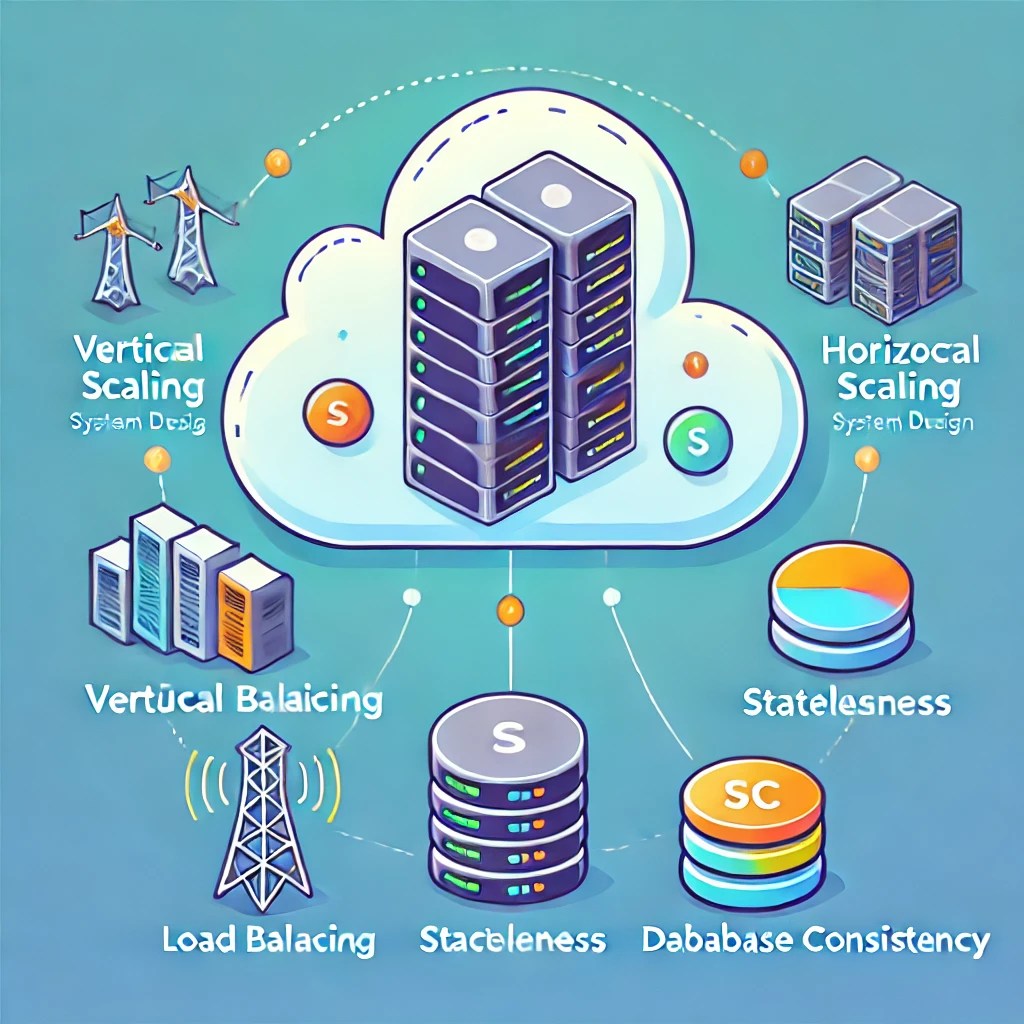
- Vertical Scaling (Scaling Up): Adding more power (CPU, RAM) to an existing machine. It’s simpler but has a limit.
- Horizontal Scaling (Scaling Out): Adding more machines to a system. It’s more complex but offers greater flexibility and capacity.
Key Principles:
- Statelessness: Design components to be stateless to make scaling easier.
- Load Balancing: Distribute traffic across multiple servers to ensure no single server is overwhelmed.
- Caching: Store frequently accessed data in temporary storage to reduce load on primary resources.
Scalability in Cloud Platforms:
In cloud platforms, standardization and “economy of scale” principles drive hardware design. Simply adding resources to a single instance of a service may be limited. Therefore, adopting scale-out architectures and optimizing workloads to maximize resource utilization are crucial for achieving scalability. If you’re designing a new application or modifying an existing one before migrating, this can significantly reduce your cloud costs.
Challenges:
- Data Consistency: Ensuring data remains consistent across multiple nodes.
- Network Latency: More nodes can introduce latency due to increased communication.
- Complexity: Managing a distributed system is inherently more complex.
Consistency in Databases:
Consistency ensures that data remains in a reliable state after interactions by applications and users. The underlying database engine governs how multiple concurrent activities from different users access data to maintain this consistency. Developers sometimes overlook consistency, assuming it’s optional. However, it’s essential because designing applications to handle concurrency anomalies in data is error-prone and time-consuming. Neglecting consistency can lead to performance issues, and developers end up writing code to address it. So, consistency should not be taken for granted.
Strategies:
- Microservices: Break down applications into smaller, independent services.
- Sharding: Split a database into smaller, more manageable pieces.
- Replication: Duplicate data across multiple machines to improve read performance and reliability.
Research Insights:
Recent research from the University of Cambridge characterizes the importance of balancing scalability and consistency in modern systems. The study highlights that optimizing for one can often complicate the other, and achieving a balance requires careful design and trade-offs. Additionally, a survey published in the Journal of Internet Services and Applications emphasizes the challenges of achieving replica consistency in cloud environments. It categorizes methods into fixed, configurable, and monitoring approaches, discussing trade-offs between consistency and performance, and offering strategies to balance these aspects effectively.
Conclusion:
Scalability is essential for building robust, high-performance systems that can grow with your user base. By understanding and implementing effective scaling strategies, you can ensure your system remains responsive and reliable as demand increases. Achieving both scalability and consistency is crucial for robust systems. Scalability ensures efficient resource utilization, while consistency guarantees data accuracy and reliability.
For more in-depth insights, explore the System Design Primer on GitHub. For further research, check out the publication on replica consistency in cloud environments here.
References:
- System Design Primer on GitHub
- University of Cambridge Research on Scalability and Consistency
- Journal of Internet Services and Applications on Replica Consistency
📚 Further Reading & Related Topics
If you’re exploring scalability concepts for software developers, these related articles will provide deeper insights:
• Mastering Cloud Scalability: Best Practices for Scalable Software Architectures – Learn how to design scalable systems on the cloud using best practices for optimizing architecture and managing large-scale applications.
• Optimizing Java Data Structures for Performance – Explore how choosing the right data structures plays a crucial role in building scalable applications, ensuring that performance remains consistent even as your system grows.








 Scalable Human Blog
Leave a comment