
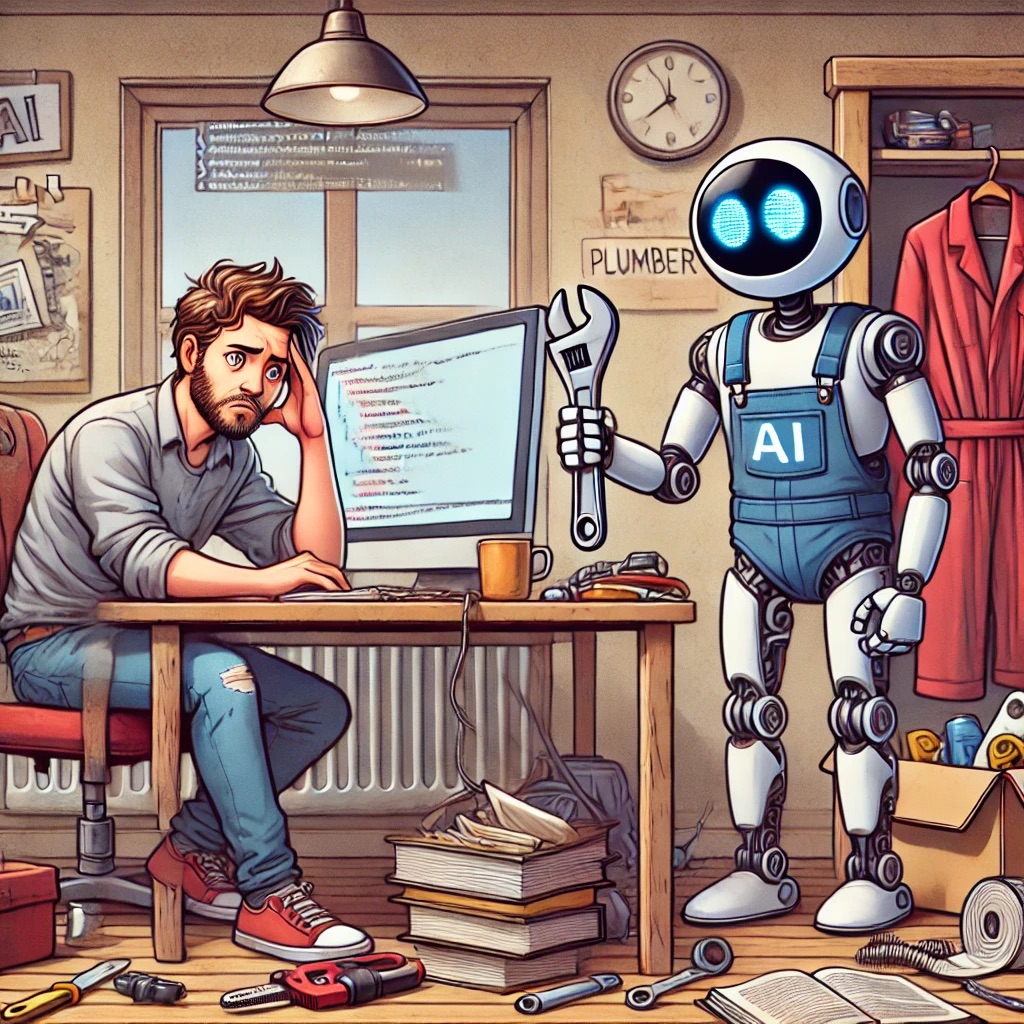
— Navigating the Rapid Evolution of AI Without Losing Our Minds (or Jobs)
Ever found yourself staring at an error message at 3 a.m., sipping your fifth cup of coffee, and wondering if you’d be happier fixing leaky faucets instead of debugging code? You’re not alone. With AI technologies evolving faster than the plot of a sci-fi thriller, it’s easy to feel like we’re sprinting on a treadmill that’s constantly accelerating. So, should we, the humble software engineers, throw in the towel and pick up a wrench? Let’s dive into this conundrum with a dash of humor and a sprinkle of existential pondering.
The Great Technological Treadmill
First off, it’s no secret that technology—and AI in particular—is advancing at a breakneck pace. Every day, there’s a new tool, a new algorithm, or a new theory promising to revolutionize the industry. As humans with a penchant for purpose, we’re scrambling to keep up, trying to align our careers and identities with these rapid changes. It’s like trying to catch a bullet train on a skateboard.
But here’s the twist: this isn’t the first time humanity has faced such a challenge. Every generation grapples with its own version of progress. Ours just happens to involve machines that might outthink us before we finish our morning coffee. We’re not just code monkeys; we’re potential technological philosophers, paving the way for future generations. Our successes and failures could become the abstract concepts and cautionary tales of tomorrow.
AI: Our Future Overlords or Overhyped Assistants?
Let’s talk about the elephant in the server room: AI’s relentless march toward… well, everything. Theories abound about humans merging with machines, brain chips interpreting our every thought, and AI handling tasks we haven’t even dreamed up yet. Companies like Neuralink are working on tech that sounds like it’s straight out of “The Matrix.” Fascinating? Absolutely. Terrifying? Maybe just a tad.
As software engineers, we can’t help but wonder how this impacts us. In the next 5-10 years, our roles might transform in ways we can’t fully predict. AI tools like ChatGPT and GitHub Copilot have already started to change how we approach coding. They’re like the new kids on the block—impressive, a bit unpredictable, and occasionally prone to weird outbursts.
The Hype vs. The Reality
Despite all the buzz, let’s pump the brakes for a moment. While AI tools have shown incredible potential, they’re not without flaws. Remember the first time you used ChatGPT and thought it was pure magic? Fast forward to today, and you might have encountered some… let’s say, “creative differences.” Like when it confidently hallucinated data while working with CSV files, leaving you questioning both its sanity and your own.
GitHub Copilot can be a lifesaver, but it often feels like that eager intern who needs constant guidance. You find yourself correcting its outputs, providing more context, and sometimes wondering if it would be quicker to code from scratch. The groundbreaking features we were promised seem to have plateaued, at least for now.
The Skeptic’s Corner
I have no doubt that AI will continue to evolve, possibly reaching heights we can’t currently fathom. However, I’m skeptical about the short-term forecasts that seem designed more to woo investors than to reflect reality. The bottlenecks are real—limited GPU availability, the enormous time and resources required to train models, and the enigmatic nature of AI “hallucinations.”
What happens if these hallucinations become more frequent or more severe? If we don’t fully understand how AI generates certain outputs, can we trust it to handle critical tasks? It’s a bit like handing your car keys to a stranger who insists they know the way but won’t tell you how.
The Human Element: Irreplaceable (For Now)
So, where does this leave us, the software engineers contemplating a career change every time AI makes headlines? Despite the doomsday predictions, our roles are still crucial. Software engineering isn’t just about churning out code; it’s about interpreting human needs, adapting to ever-changing requirements, and applying a level of creativity and critical thinking that AI hasn’t mastered yet.
Even if AI becomes more sophisticated, it will still rely on us to define problems, set goals, and interpret results. We bring context, empathy, and ethical considerations to the table—elements that are hard to code into an algorithm. Think of us as the translators between human intention and machine execution.
Plumbing the Depths: A (Mostly) Joking Alternative
Now, about that plumbing gig. Sure, there’s a certain appeal to a job where the biggest surprise is a stubborn clog rather than a rogue AI. But let’s be honest—we love the challenges and the triumphs that come with software engineering. Plus, have you seen the stuff plumbers have to deal with? Talk about debugging!
Embracing the Journey
In the grand scheme of things, we’re part of an exciting (if occasionally anxiety-inducing) journey. The key is not to resist the change but to adapt alongside it. By staying curious, continuing to learn, and maybe maintaining a healthy skepticism, we can find our place in this rapidly evolving landscape.
So, should we throw in the towel? Nah. Maybe keep it handy for the occasional stress-induced sweat, but don’t toss it just yet. After all, someone’s got to be around to fix the AI’s mistakes—and it’s not going to be the plumbers.
Final Thoughts
The future is unwritten, and while AI is a significant part of that story, so are we. Let’s keep coding, keep questioning, and maybe keep a plunger nearby—just in case.
Remember, as overwhelming as the tech world can be, we’re all in this together. And if all else fails, there’s always stand-up comedy. Or plumbing school applications. Your call.
📚 Further Reading & Related Topics
If you’re exploring the impact of AI on software engineering and career choices, these related articles will provide deeper insights:
• Why AI May Never Fully Replace Programmers: The Human Element in Software Development – Understand why human creativity, problem-solving, and domain expertise remain irreplaceable despite advancements in AI-generated code.
• The Myth of the Full-Stack Developer – Explore how industry expectations and evolving technology impact software engineers’ roles, making specialization and adaptability crucial in the AI-driven era.







 Scalable Human Blog
Leave a comment