
- To start, lets consider the write to be successful when it is only processed by only 2 of the 3 replicas ✅
- What if 1 of the 3 replicas accepted the write… How far can we push this 🤔
- If we know every write guaranteed out of 2 of the replicas that means 1 replica could be stale 😵
- Therefore, if we read from at least 2 replicas at least we know that 1 replica of the two is update to date 💡
- If the 3rd replica is down or slow to repond
- Reads can continue returning up to date values
- If the 3rd replica is down or slow to repond
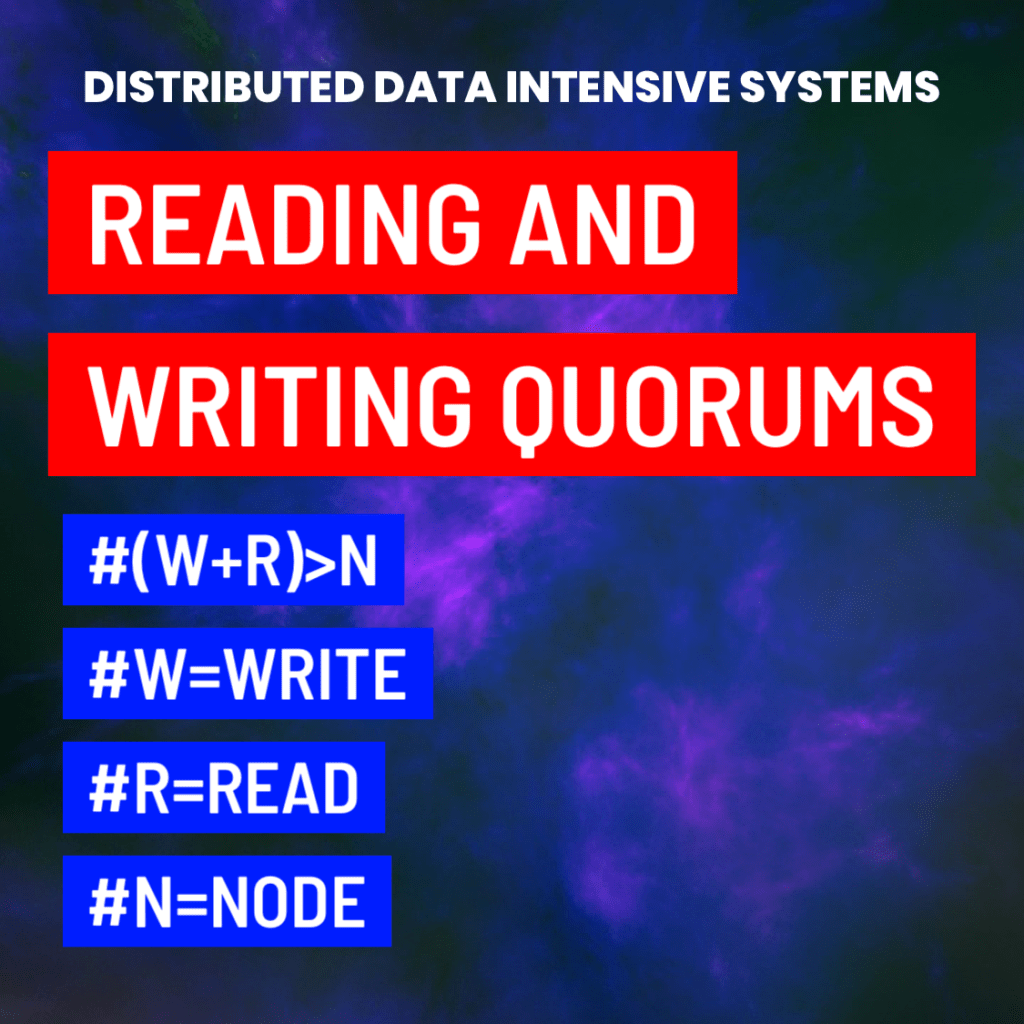
Illustrate the Quorum Variables
- W = Minimum write nodes ✍️
- R = Minimum read nodes 📖
- N = Nodes in the quorum group 📚
Summary of Quorum
- More generally if there are N replicas 📚
- Every write must be confirmed by W nodes ✍️ to be considered successful.
- We must query R nodes 📖 for each query
- Because at least R nodes 📖 will be at least up to date
Reads and writes that obey this R 📖 and W ✍️ values are called Quorum reads and writes.
- You can think R 📖 and W ✍️ as the minimum number of votes for the read to be valid.
In a Dynamo style databases:
- The parameters N 📚, W ✍️ and R 📖 are typically configurable
- Note, there maybe more than N 📚 nodes in a cluster
- But any given value will be stored only on N 📚 nodes
- This allows for data sets to be partitioned
- Supporting data sets that are larger that can fit on 1 node
The Quorum Condition (W+R) > N
The (W+R) > N allows us to tolerate theses nodes with these types of stipulations:
- If W < N we can still process writes if a node is unavailable
- If R < N we can still process we can still process reads if a node is unavailable
For example:
- 📚 N = 3
- ✍️ W = 2
- 📖 R = 2
- We can tolerate one unavailable node
Similarly:
- 📚 = 5
- ✍️ W = 3
- 📖 R = 3
- We can tolerate 2 unavailable nodes
Normally reads and writes are always to all N 📚 replicas in parallel.
👉 Tip: The parameters N and R determine how many node we wait for…
- That is how many of the N nodes needed to report success before we consider the read and write to be successful.
👉 Tip: If there are fewer W or R nodes are available writes will return errors
- Nodes can be unavailable for many reasons
- Node down
- Crashing
- Powering down
- Error in an operation
- Inability to write as the disc is full
- Due to a network interruption between the client and the node
- Etc..
- We only care if whether the node returns a successful response
- And we do not need to distinguish between different kinds of faults
📚 Further Reading & Related Topics
If you’re exploring quorum-based reading and writing in distributed systems, these related articles will provide deeper insights:
• Distributed Data-Intensive Systems: Limitations of Quorum Consistency – Understand the trade-offs and challenges of quorum consistency in distributed databases.
• Resolving Write Conflicts in Distributed Data-Intensive Systems – Learn how distributed systems handle write conflicts, an important aspect of quorum-based replication.








 Scalable Human Blog
Leave a reply to Distributed databases – Is Performance, Scalability and Transactional Guarantees Achievable? – Scalable Human Blog Cancel reply