
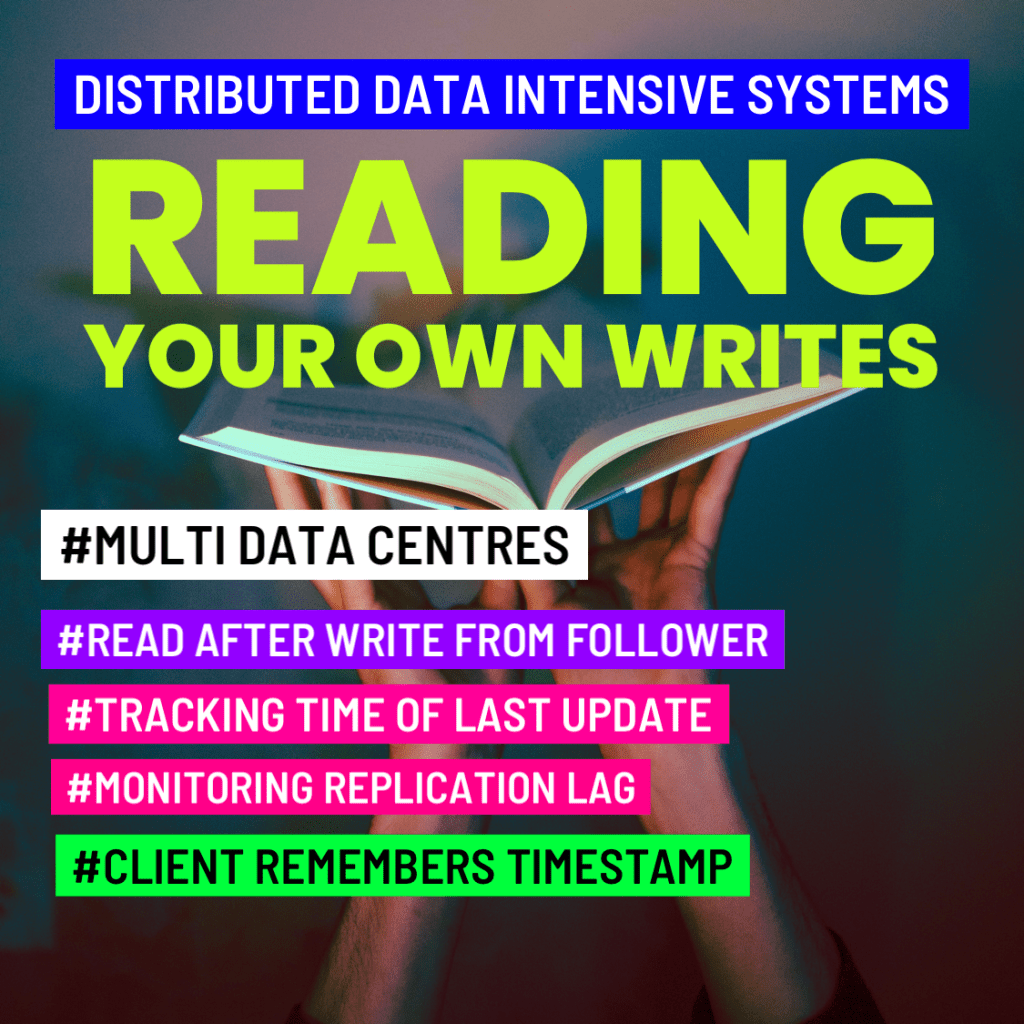
Reading after write consistency… aka (read your writes consistency)
What does this mean?
- Guarantees when a user reloads a page they can see any updates they done themselves
- Although makes no promises about other users
- Other user updates maybe available at some other later time
- This is achieved reassuring the user that there input has been inserted in correctly
How do we implement read after write consistency?
There are numerous number of techniques, here are a few:
Example 1
- When a user is reading something, it may have modified and read it from the leader
- Otherwise they have read it from a follower…
- This way you know if something may have been modified without querying it 🤔
Example, social media website…
- 👉 The user of the profile is only able to edit there profile
- 👉 Thus a simple rule, the user should always read there profile from the leader and any other user profiles from a follower
⚠️ If most things are editable by the users this is not an affective approach! 👎
- As most things are read by the leader node, therefore negating the benefits of read scaling 👎
Example 2
In the case above an alternative maybe used to decided a read from a leader.
- For example, you can track the time of the last update and for one minute after the last update make all reads from the leader
- You can also monitor the Replication Lag on the followers and prevent queries on any follower that is any more than one minute behind the leader ✅
Example 3
Another technique is to have the client remember the timestamp of the most recent write.
- Then the system can ensure the replica serving any reads for that user reflects updates at least until that time stamp ✅
- If a replicas is not sufficiently up to date then either read can be handled by another replica, or query can wait until replica is up to date
- Timestamps can be logical timestamp, something that indicates ordering of writee such as the log sequence number or the actual system clock which means clock synchronisation becomes critical! 🕗
Multi data centre considerations
Keep in mind your replicas are distributed across multiple data centres for geographical proximity to users, or for availability… there is additional complexity! ⚠️
Another complication can occur, when a user is accessing the same service from multiple devices! ⚠️
- For example, a desktop and a mobile
- If a user enters information on one device, the user should be able to see this on another device 🤷♂️
- In this case there some additional issues to consider
- ❌ Approaches that require remembering the timestamp of the last users update become more difficult (example 3) ⚠️
- 👉 Because the code on one device does not know what happened on the other device…
- 👉 This metadata will need to be centralised
- In this case there some additional issues to consider
- If a user enters information on one device, the user should be able to see this on another device 🤷♂️
- If replicas are distributed across different data centres
- This guarantee the connection will be routed to the same data centre
- Example: a user uses the home broadband connection
- The other device uses cellular data network, and the device network routes maybe completely different! 🤪
- Example: a user uses the home broadband connection
- This guarantee the connection will be routed to the same data centre
👉If your approach requires reading from the leader you will first need to route all the user devices requests to the same data centre.
📚 Further Reading & Related Topics
If you’re exploring data consistency and read-your-own-writes guarantees in distributed systems, these related articles will provide deeper insights:
• Distributed Data-Intensive Systems: Logical Log Replication – Learn how logical logs help maintain data consistency and ensure recent writes are visible across distributed nodes.
• What Is Leaderless Replication in Distributed Systems? – Explore how leaderless replication affects consistency guarantees, including challenges in ensuring users can always read their own writes.








 Scalable Human Blog
Leave a reply to What is Replication and Why is it Important? – Scalable Human Cancel reply