
Swapping two numbers without using a temporary variable is a fundamental problem in computer programming that tests one’s ability to think logically and creatively. It requires a deep understanding of basic programming concepts and the ability to solve problems through analytical thinking.
This skill is especially important in programming contexts where memory usage and performance optimization are critical, as using a temporary variable to swap two numbers may not be efficient or practical.
By learning how to swap two numbers without using a temporary variable, you demonstrate a mastery of basic programming concepts and problem-solving skills that are essential in any programming environment. This skill can also serve as a foundation for more complex problem-solving techniques, allowing you to tackle even more challenging programming problems with confidence and proficiency.
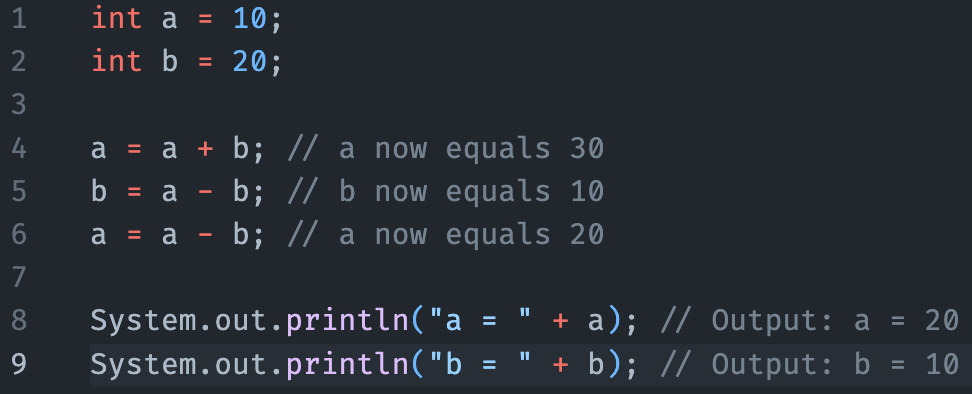
How do we achieve this?
- Declare two integer variables
aandband assign them initial values. - Add the value of
btoaand store the result ina. - Subtract the original value of
bfrom the new value ofaand assign the result tob. - Subtract the original value of
afrom the new value ofa(which now equalsa + b) and assign the result toa. - The values of
aandbhave now been swapped. You can use them as needed in your program.
Code example…
int a = 10;
int b = 20;

a = a + b; // a now equals 30
b = a - b; // b now equals 10
a = a - b; // a now equals 20

System.out.println("a = " + a); // Output: a = 20
System.out.println("b = " + b); // Output: b = 10
Final Note
Knowing how to swap two numbers without using a temporary variable is important because it demonstrates a fundamental understanding of basic programming concepts and problem-solving skills.
It also shows that you are able to think creatively and use logic to solve problems. This skill is useful in a wide range of programming contexts, from simple arithmetic operations to complex algorithms and data structures.
Additionally, in some cases, using a temporary variable to swap two values may not be possible or efficient, especially in memory-constrained environments or high-performance applications. In these cases, being able to swap two numbers without using a temporary variable can be a valuable optimisation technique!
📚 Further Reading & Related Topics
If you’re interested in Java algorithms and optimization techniques, these related articles will provide further insights:
• How to Check if a Linked List Contains a Loop in Java – Learn an efficient algorithm to detect cycles in linked lists, a common coding interview question.
• Write a Java Program to Check if a Number is Prime or Not – Explore another classic problem that tests logic, efficiency, and algorithmic problem-solving skills in Java.








 Scalable Human Blog
Leave a reply to Turn It Around: Reversing a Number in Java – Scalable Human Blog Cancel reply