
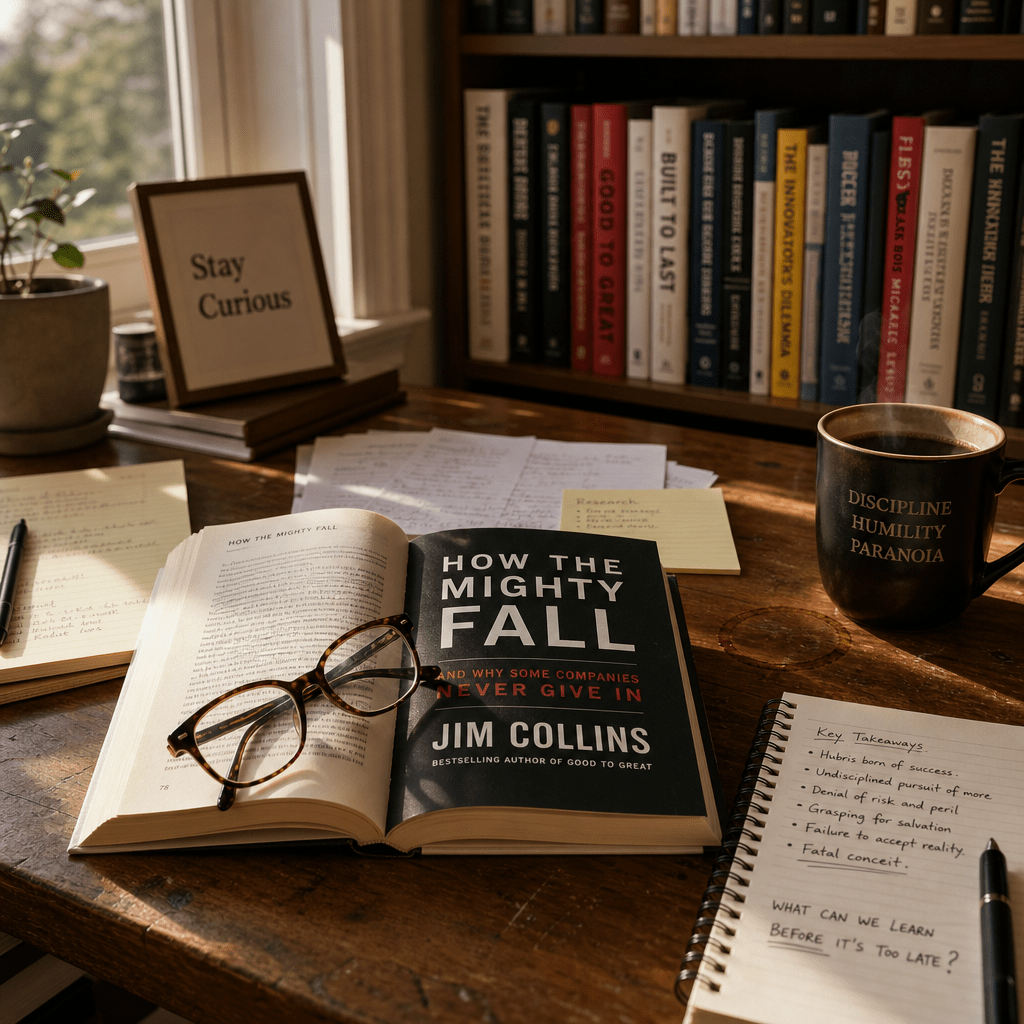
TL;DR: How the Mighty Fall by Jim Collins reveals that organizational decline often happens gradually and invisibly, following a predictable pattern that can be detected and reversed if caught early. The book outlines five stages of decline, highlighting that success can lead to arrogance, undisciplined growth, denial, panic, and eventual failure.
Introduction
How the Mighty Fall feels like the darker companion to Jim Collins’ Good to Great. While Good to Great explores how companies become exceptional, How the Mighty Fall delves into how those same companies can lose their way. The book’s core message is that great companies rarely collapse overnight. Instead, decline often begins quietly, unnoticed even as the business seems successful from the outside. Collins argues that failure is not random bad luck but follows a detectable pattern, which can be addressed before it’s too late.
Success Can Become a Trap
Success creates momentum, but it can also create arrogance. Companies may become insulated by their past achievements, leading them to forget the real reasons behind their success. Leaders might confuse good outcomes with superior judgment, underestimating factors like luck, timing, and market conditions. As described on Jim Collins’ official site, Stage 1, Hubris Born of Success, is when organizations lose sight of what truly made them successful.
Growth Without Discipline Can Be Dangerous
More is not always better. Companies often pursue more products, markets, hiring, acquisitions, and complexity. However, without discipline, this can dilute what made the organization strong. Collins’ second stage, Undisciplined Pursuit of More, highlights how growth can hide weaknesses, making a company appear ambitious while it becomes less focused. This insight is particularly relevant today as companies chase trends and scale without considering if they are still operating with discipline.
Decline Is Often Invisible at First
Companies can be internally weakening while externally looking fine. Revenue or brand strength can mask deeper problems, and leaders may ignore uncomfortable data. Teams might stop having honest conversations, and bad decisions can be explained away as temporary issues. The Readingraphics summary emphasizes that by the time decline is obvious, the organization may already be deep into the process.
Beware the Silver Bullet
When things go wrong, weak organizations often look for dramatic salvation, such as hiring a celebrity CEO or making a big acquisition. However, the book is skeptical of miracle cures. Collins suggests that lasting recovery usually comes from discipline, not panic. In today’s business world, companies can easily chase the latest trend without asking if it truly strengthens the core business.
The Book Is Ultimately Hopeful
Despite its focus on decline, the book offers hope. Collins’ framework is not just a post-mortem but can be used as a warning system. Organizations can recover before reaching the final stage if they embrace humility, discipline, and honest leadership. The research on Jim Collins’ official page provides “well-founded hope” that decline can be reversed.
Key Takeaways
- Past success does not guarantee future success: Habits formed today can lead to tomorrow’s failure.
- Arrogance is often the first sign of decline: Decline begins when leaders stop being curious, humble, and disciplined.
- Growth can become a form of overreach: Not all expansion is progress; some growth creates fragility.
- Warning signs are easy to ignore: The most dangerous problems are often the ones that can be explained away.
- Panic is not strategy: Chasing a dramatic rescue can accelerate the fall.
- Recovery requires discipline, not theatre: Companies that survive return to fundamentals.
- Lessons apply beyond business: These stages can apply to careers, personal projects, and even personal habits.
Conclusion
How the Mighty Fall is a compelling exploration of organizational decline that offers valuable insights for businesses and individuals alike. It reminds us that success can make us blind, growth without discipline is dangerous, and recovery requires a return to fundamentals. Whether you’re leading a company or managing personal goals, the lessons from this book are universally applicable, urging us to remain vigilant and disciplined in our pursuits. Engage with these insights, explore further, and consider how they apply to your own journey.
📚 Further Reading & Related Topics
If you’re exploring how companies succeed and fail, these related articles will provide deeper insights:
• Extreme Ownership and Dichotomy of Leadership Review – This review discusses leadership principles that can prevent organizational decline, complementing the themes in “How the Mighty Fall.”
• Why Move Fast and Break Things Might Break Your Business – This post critiques the “move fast” philosophy in tech, which can contribute to the decline of companies, similar to the themes explored in Collins’ analysis of business failures.









Leave a Reply