
TL;DR: I have started building Open Duck Mini V2, an open source humanoid robot, and I am documenting the whole process as an engineering journal. What began as “this looks fun” is quickly becoming a hands on lesson in 3D printing, mechanics, electronics, wiring, calibration, and software.
I spend a lot of time building software, where progress often lives in commits, logs, dashboards, and invisible systems. That work is satisfying, but building a physical robot hits differently.
A printed foot sits on the desk. A spacer either fits or it does not. A screw hole lines up, or it teaches you something.
That is why I started building Open Duck Mini V2. It is fun, but it also feels like a useful direction to explore. As AI becomes more common in software engineering, I suspect more engineers will benefit from being comfortable across the full stack of reality: software, electronics, mechanics, sensors, motors, power, and physical constraints.
I am tracking the project in my own Open Duck Mini build journal, where I am documenting the tools I bought, the parts I printed, the mistakes I made, and the decisions I took along the way.
From software project to physical object
Open source software usually starts with a repo, a README, some dependencies, and a build command.
This project starts with all of that, but then it keeps going.
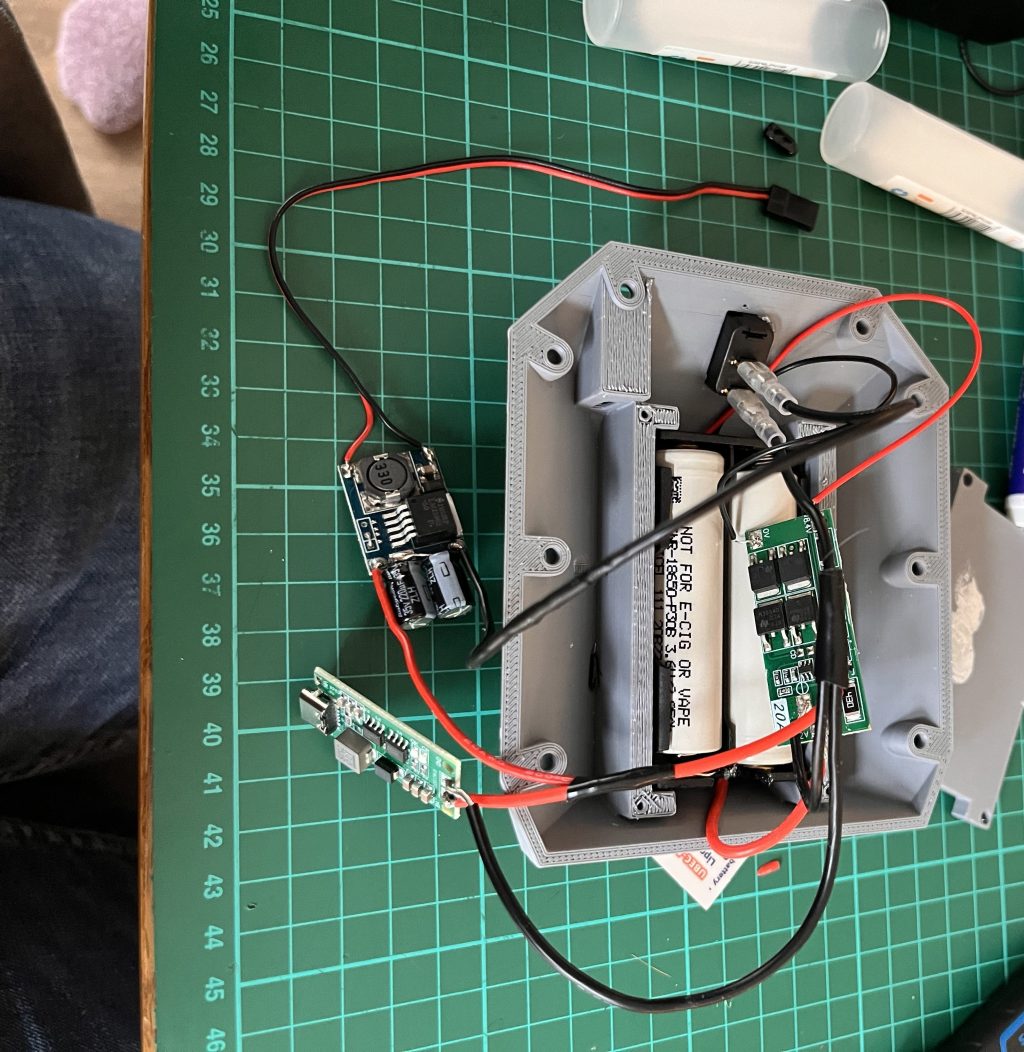
You need printed parts. Screws. Inserts. Bearings. Servos. Wire. Threadlocker. A Raspberry Pi. A servo driver board. An IMU. Foot switches. Battery wiring. Patience.
The official Open Duck Mini V2 assembly guide makes that very clear. It walks through the robot in stages: trunk, feet, shins, thighs, hips, neck, head mechanism, electronics, battery pack, and body.
That order matters. This is not just a printing checklist. It is a real assembly process.
One detail from the guide stood out early: motors should be configured before assembling the robot. That is exactly the kind of thing a software person might underestimate. In code, you can often configure late. In hardware, the order of operations can decide whether something is easy, annoying, or impossible without taking half the robot apart again.
The joy of watching pieces appear
The most rewarding part so far has been watching the robot appear piece by piece.
A single printed part does not feel like much. A foot. A spacer. A trunk component. A neck bracket. A head linkage.
But over time, the pile changes character. It stops looking like random plastic and starts looking like a machine waiting to happen.
At the moment, my build journal repo tracks:
- 30 of 49 required printed parts completed
- 61 percent printing progress
- 28 percent overall build progress
- Next prints:
head_roll_mount.stlandhead_bot_sheet.stl
That still feels early, but it has crossed an important line. This is no longer just an idea. It is an actual build.
The repo now includes my workshop setup, printing progress tracker, build log, photos of printed parts, purchase planning, mistakes, reprints, and a README progress bar. It has become less like a notes folder and more like a proper engineering journal.
3D printing is not “press print and wait”
One of the first lessons was simple: 3D printing is more active than it looks.
Before starting, it is easy to imagine the workflow as:
- Download file
- Press print
- Receive perfect part
Reality has more texture.
Orientation matters. Supports matter. Bed adhesion matters. Some parts come out rough but still usable. Others look fine until you check whether the screw holes line up. A part can be ugly and functional, or pretty and wrong.
That has changed how I judge progress.
A finished print is not automatically a finished part. It needs a quick inspection:
- Do the holes line up?
- Do screws fit?
- Are support marks cosmetic or structural?
- Is the layer quality good enough for the load?
- Would reprinting save pain later?
This is where the project becomes interesting. The robot teaches you to think physically. You stop asking only “did it build?” and start asking “will it assemble, move, survive, and be serviceable?”
Documentation makes the project feel real
I started documenting because I did not want to lose track of what I had done.
Then something unexpected happened: the documentation made the project feel more real.
The build journal gives the project memory. It shows the decisions, not just the results. It tracks purchases, setup work, printing progress, photos, fit checks, and notes on problems.
That matters because physical projects have a way of scattering information everywhere. A receipt in one place. A slicer setting somewhere else. A note about a bad print in your head. A photo on your phone. A link in a browser tab.
Putting it all in one repo turns the mess into a story.
It also makes mistakes less frustrating. A failed print is not just wasted filament. It becomes a logged observation. A reprint becomes a decision. A rough edge becomes a note for the next person, even if the next person is future me.
This is bigger than a duck
Despite the name, I do not feel attached to making the final robot look like a duck.
The project is called Open Duck Mini, but what interests me most is the idea of turning it into a small humanoid character. Maybe something with a Star Wars inspired personality. Something expressive, useful, and a little weird in the best way.
Longer term, I would like it to become more than a stock robot. It could become a personal assistant that interfaces with my notes, answers questions, or connects with parts of my home automation setup.
That is still far away. First, it needs legs. And wiring. And calibration. And probably several moments where I wonder what I have got myself into.
But the possibility is motivating.
It is not hard to imagine a future where people build small robots for specific jobs at home, in workshops, or as tiny businesses. Not general purpose sci fi robots, but practical, customized machines with personality and narrow usefulness.
Software engineers may not all become robot builders. But I think more of us will need to understand how software touches the physical world.
The real stack includes everything
The official assembly guide is a good reminder that this kind of robot is a full stack project in the most literal sense.
It includes:
- Mechanical assembly, with printed parts, screws, inserts, bearings, and threadlocker
- Electronics, including servos, foot switches, an IMU, a servo driver board, and Raspberry Pi Zero 2 W
- Power systems, including battery wiring and safe routing
- Calibration, because motors and sensors need to agree with reality
- Software setup, because the robot still needs code to become more than plastic and parts
That combination is what makes the project exciting. It is also what makes it humbling.
In software, errors can often be fixed with a patch. In hardware, an error might mean a stripped insert, a cracked part, a bad wire route, or a reprint. The feedback loop is slower, but it is also more tactile.
You learn by touching the thing.
Key Takeaways
- Building a robot is not just a software project with extra steps. It combines printing, assembly, wiring, calibration, and code.
- Documentation turns chaos into progress. A build journal helps track decisions, mistakes, parts, purchases, and lessons learned.
- 3D printing requires judgment. A part does not need to be perfect, but it does need to fit and function.
- Order matters in hardware. The Open Duck Mini V2 guide recommends configuring motors before assembly, which can save trouble later.
- The project is a bridge between disciplines. It is a practical way to move from pure software into physical systems.
Conclusion
Building Open Duck Mini V2 has already changed how I think about engineering.
It started because it looked fun, and it still is. But it is also becoming a way to practice a broader kind of building, one where code meets plastic, screws, sensors, motors, and mistakes you can hold in your hand.
For now, the goal is simple: keep printing, keep documenting, and keep learning.
The robot is not walking yet, but it is becoming real.
📚 Further Reading & Related Topics
If you’re exploring building a software powered physical robot, these related articles will provide deeper insights:
• Embracing Robotics in the AI Era : A natural companion for understanding why software engineers should experiment with robotics, especially when moving from code into physical systems.
• Incorporating AI and Blockchain in IoT, Healthcare, and Supply Chain : Explores connected devices and intelligent systems, which complements the hardware and software integration challenges involved in robotics projects.
• How to Become a CPU Programmer : Useful for readers interested in the lower level computing concepts behind robotics, embedded systems, and performance sensitive hardware control.




Leave a comment